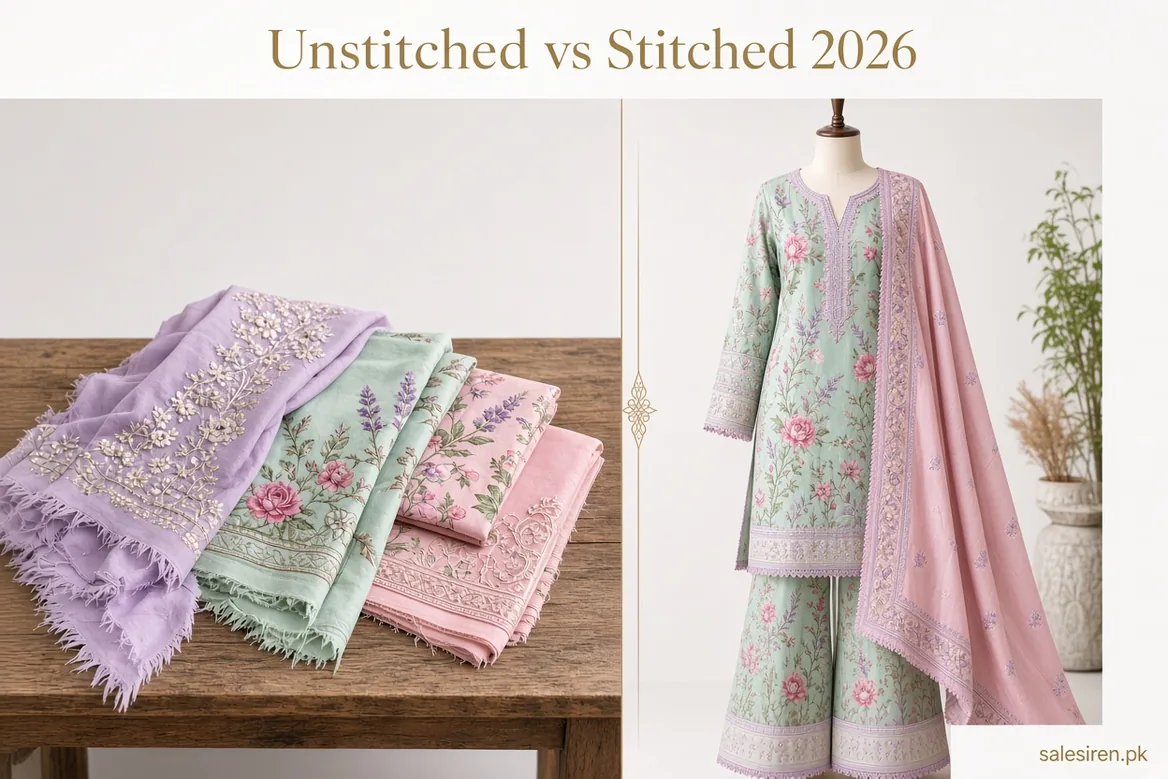
Unstitched vs Stitched 2026: At Two Brands the Unstitched Suit Costs More
Every Pakistani woman is taught the same rule. Unstitched is cheaper, stitched is lazy. Buy the fabric, take it to your darzi, save money. That is the unstitched vs stitched rule every household runs on.
I measured it across every brand that sells both, and at two of them the unstitched suit actually costs more before you have paid the tailor a single rupee.
Chalo, asli hisaab dekhte hain.
Unstitched vs Stitched: The Comparison Nobody Runs
The old rule survives because almost nobody runs the unstitched vs stitched comparison properly. You need the same brand, the same week, both ranges measured together. That is what I did across 22,804 discounted garments.
Yaad rakhne wali baat
An unstitched price is never the final price. Nobody publishes what your own darzi charges, so the only rate we can quote is a brand’s: Cross Stitch prints Rs 4,500. Ask your tailor, then add his number. Darzi ka kharcha bhi jorho.
Unstitched vs Stitched, Brand by Brand
| Brand | Unstitched (median) | Stitched (median) | Difference | Which is dearer |
|---|---|---|---|---|
| Asim Jofa | Rs 6,690 | Rs 4,050 | +Rs 2,640 | Unstitched |
| Bonanza Satrangi | Rs 4,734 | Rs 2,443 | +Rs 2,291 | Unstitched |
| Almirah | Rs 4,658 | Rs 6,080 | -Rs 1,422 | Stitched |
| Beechtree | Rs 3,493 | Rs 4,893 | -Rs 1,400 | Stitched |
| Maria B | Rs 10,914 | Rs 15,192 | -Rs 4,278 | Stitched |
Median price after discount in each range, live product data, 27 August 2026. Only brands with 10 or more items measured in both ranges appear. Tailoring is not included.
Two brands break the unstitched vs stitched rule outright. At Asim Jofa the unstitched suit is Rs 2,640 dearer than the stitched one, and that is before the darzi. Add Cross Stitch’s published Rs 4,500 and the gap opens to Rs 7,140.
At Bonanza Satrangi it is nearly double, Rs 4,734 against Rs 2,443. Yahan purana usool bilkul ulta hai.
Why Unstitched Sometimes Costs More Than Stitched
The unstitched vs stitched gap is not brands being sneaky. It is a product mix effect, and knowing it makes you a better shopper.
- Unstitched carries the newest prints. This season’s lawn arrives unstitched first, at full price.
- Unstitched means more fabric. A three piece set is shirt, trouser and dupatta in full yardage. A stitched kurti is one piece.
- Stitched includes cheap singles. Kurtis, tops and separates pull that median down.
- Ready to wear clears faster. Size bound stock gets discounted harder.
So you are rarely comparing one suit in two forms, just two product mixes sharing a brand name.
Unstitched vs Stitched: Which Gets Discounted Deeper
Median discount by range, at brands selling both
Live data, 27 August 2026
Where the two differ, stitched is discounted harder, to clear size bound stock.
On unstitched vs stitched discounting the pattern is consistent. Stitched gets the deeper cut, because a finished garment in the wrong size is dead stock, and fabric keeps.
Maria B is the sharpest example, 25 percent off stitched against 15 percent off unstitched. Almirah and Asim Jofa apply the same flat cut to both.
Unstitched vs Stitched: The Real Maths
Nobody publishes what your darzi charges, so we will not invent a rate. Here is the break even instead: the most you can pay for stitching before unstitched stops being cheaper.
| Brand | Unstitched | Stitched | Break even stitching | At Cross Stitch’s Rs 4,500 | Winner |
|---|---|---|---|---|---|
| Beechtree | Rs 3,493 | Rs 4,893 | Rs 1,400 | Rs 7,993 | Stitched |
| Almirah | Rs 4,658 | Rs 6,080 | Rs 1,422 | Rs 9,158 | Stitched |
| Asim Jofa | Rs 6,690 | Rs 4,050 | Rs 0 | Rs 11,190 | Stitched |
| Bonanza Satrangi | Rs 4,734 | Rs 2,443 | Rs 0 | Rs 9,234 | Stitched |
| Maria B | Rs 10,914 | Rs 15,192 | Rs 4,278 | Rs 15,414 | Stitched, just |
Break even is the stitched median minus the unstitched median, arithmetic on two measured prices. Rs 0 means the finished suit is already cheaper, so no tailoring can rescue the fabric. The last column adds Rs 4,500, the charge Cross Stitch prints on its own pages. Nobody publishes a neighbourhood darzi’s rate, so read break even against your own tailor’s quote.
Read it as a budget, not a verdict. Beechtree and Almirah give you about Rs 1,400 to spend on stitching, Asim Jofa and Bonanza Satrangi give you nothing, and only Maria B leaves real room at Rs 4,278. On the one published rate, stitched wins at all five. Unstitched wins only where your own darzi undercuts the gap.
That is close to the opposite of the rule most of us grew up with. Ammi ka usool har jagah nahi chalta.
The Unstitched vs Stitched Returns Trap
Ruko! Yeh parhna zaroori hai
Elan and Maria B use the same words: “Unstitched articles once stitched will not be entertained.”
This is the unstitched vs stitched risk nobody prices in. The moment your darzi cuts the cloth, the purchase is final, whatever the brand’s window says. A flaw you spot after stitching is your loss.
Stitched carries the opposite risk, a bad fit you cannot alter, and 17 of the 19 brands in our returns table refuse sale returns anyway. Dono taraf risk hai.
How to Choose Between Unstitched and Stitched
- Ask your darzi his rate before running an unstitched vs stitched comparison. Nobody publishes it, and it changes most of these answers.
- Check both prices at the same brand, same week. The gap moves constantly.
- Choose unstitched if your measurements are unusual or you want a specific cut. That is what tailoring is for.
- Choose stitched if you are ordering online in a sale, since it is discounted deeper and you skip the wait. Beechtree and Asim Jofa both make this easy to check.
- Inspect fabric before it goes to the darzi. After cutting no brand will help, and the Competition Commission of Pakistan handles deceptive advertising, not buyer regret.
- Compare across brands too. Our 19 brand comparison shows where each sits.
Returns Compared Across Every Brand
| Brand | Window | Sale items | Money back? | Return postage |
|---|---|---|---|---|
| Gul Ahmed | 30 days | Not in the exclusion list | No cash refund | Free pickup |
| Bachaa Party | 30 days | Discounted purchases excluded | Delivery charges non-refundable | You send it |
| Cross Stitch | 30 days | Sale items excluded | Exchange only | Free where available |
| Almirah | 15 days | Only if wrong item sent | Refund excludes shipping | You send it |
| Sana Safinaz | 14 days | Not eligible for exchange | Store credit | You pay |
| Edenrobe | 14 days | Not if 50% off or above | Exchange only | Brand pays if faulty |
| Bonanza Satrangi | 14 days | Cannot be exchanged or refunded | No refund policy | You pay |
| Beechtree | 7 to 14 working days | Not eligible for exchange | Store credit only | Brand pays if their error |
| Asim Jofa | 3 working days | Not eligible for exchange or refund | Coupon, or card if approved | You pay |
| J. Junaid Jamshed | 3 days | Only if wrong item sent | Store credit voucher | You pay |
| Generation | 24 hours | Defect proof required | Coupon, no cash | Brand collects |
| Ethnic by Outfitters | 14 days | Size exchange only | Exchange only | Free return shipping |
| Limelight | 7 working days | Cannot be exchanged | Strict no refund policy | You send it |
| Minnie Minors | 30 days | Sale items cannot be exchanged or refunded | Strict no refund except defects | You send it |
| Nishat Linen | 14 days | Cannot be exchanged or returned | Coupon, valid 7 days only | You send it |
| Baroque | 10 days | Cannot be exchanged unless faulty | Coupon if item unavailable | You pay, plus Rs 500 |
| Alkaram Studio | 7 days | Cannot be returned or exchanged | Refund only if defective | You send it |
| Zeen | 10 days | Not entertained | No refund policy | You send it |
| Elan | 7 days, faults only | Cannot be returned or exchanged | No refund or money back guarantee | You pay |
Every entry read directly from the brand’s own published returns or exchange policy on 20 August 2026, and re-read for 15 of the brands on 27 August 2026. Where a policy does not mention sale items at all, the table says so rather than assuming they are covered. Policies change, so check the brand site before you pay.
Note the pattern for unstitched buyers. Even generous windows exclude sale stock, so the tailoring clause is usually academic. Gul Ahmed is the one exception.
Compare live prices across 20 brands
Unstitched and stitched, measured from each brand’s own product data.
See the full comparisonUnstitched vs Stitched FAQs
Is unstitched cheaper than stitched in Pakistan?
Not always, and that is the surprise. At Asim Jofa the median unstitched piece costs Rs 6,690 against Rs 4,050 stitched. At Bonanza Satrangi it is Rs 4,734 against Rs 2,443. At Beechtree, Almirah and Maria B the usual pattern holds and stitched costs more.
How much does tailoring cost in Pakistan in 2026?
No Pakistani brand publishes what a neighbourhood tailor charges, so we will not invent one. The only published rates are brand stitching services: Cross Stitch charges Rs 4,500 and Charizma lists nine tiers from Rs 3,060 to Rs 7,650. A local tailor usually asks less, but the only honest figure is the one yours quotes you.
Which is better value, unstitched or stitched?
Compare the gap between the two prices at one brand with what your own tailor charges. At Beechtree stitched costs Rs 1,400 more than unstitched, so unstitched only wins if your tailor works for less than Rs 1,400. At Maria B the gap is Rs 4,278, far easier to beat. At Asim Jofa stitched is cheaper before any stitching at all.
Why is unstitched sometimes more expensive?
Because unstitched and stitched are not the same garment. Unstitched ranges carry the newest prints and heavier fabric quantities, while stitched ranges include simple kurtis and single pieces. You are comparing two product mixes, not one suit in two forms.
Does unstitched fabric get discounted as deeply as stitched?
Usually less. At Beechtree unstitched sits at a median 30 percent off against 40 percent stitched. Maria B discounts unstitched 15 percent against 25 percent. Almirah and Asim Jofa are the exceptions, discounting both equally.
Can I return unstitched fabric after it is stitched?
No. Every brand we read is explicit. Elan and Maria B both state that unstitched articles once stitched will not be entertained. Once your darzi cuts the cloth, the purchase is final whatever the other policy says.
Is ready to wear worth the premium?
Often yes, once you count the full cost. Ready to wear carries no tailoring bill, no waiting and no risk of a bad cut. Charizma is the clearest case: 109 of its 112 sale items are ready to wear, at a typical Rs 7,916 finished.
Keep reading
- Asim Jofa Sale 2026. Stitched beats unstitched outright
- Charizma Sale 2026. 97 percent ready to wear
- Beechtree Sale 2026. Unstitched at a median Rs 3,493
- Nishat Linen Sale 2026. Ready to wear saves Rs 3,702
- Lawn Sale Pakistan 2026. Every brand ranked
- Best Pakistani Brand by Budget. What each budget buys
The Bottom Line on Unstitched vs Stitched
The rule that unstitched vs stitched always favours unstitched is not true in 2026. At Asim Jofa and Bonanza Satrangi the fabric costs more than the finished garment before tailoring.
Your stitching budget is the gap between the two prices, and at Cross Stitch’s published Rs 4,500 stitched wins at all five.
So the honest unstitched vs stitched answer: buy unstitched when you need a particular fit or fabric. Buy stitched in an online sale, discounted harder and with no second bill. Hisaab lagao, phir faisla karo.
How we checked: Prices come from the live product feeds of 20 Pakistani brands on 27 August 2026, covering 22,804 discounted garments. A brand appears only where at least 10 items could be measured in both its unstitched and its stitched or ready to wear ranges, which is why five appear rather than twenty. Medians are used throughout, so half of each range is cheaper than the figure given. We do not estimate what a tailor charges, because no brand publishes a neighbourhood darzi’s rate. The stitching figures here are published brand charges, Rs 4,500 at Cross Stitch and Rs 3,060 to Rs 7,650 at Charizma, a small sample of two brands. Break even is arithmetic on the two measured medians. Policy wording is quoted verbatim from each brand’s published pages. Prices move during a sale, so confirm on the product page before buying.